What is stress, and how does it affect our bodies? Is worry a root of stress? What about anxiety? Most importantly, what does the Bible say about stress and anxiety?
According to mentalhealth.org, stress “stress is the feeling of being overwhelmed or unable to cope with mental or emotional pressure.”
According to Don Colbert, M.D, “stress is mental or physical tension, strain or pressure.”
However, stress researchers and authors Doc Childre and Howard Martin say, “stress is the body and mind’s response to any pressure that disrupts their normal balance. It occurs when our perceptions of events don’t meet our expectations, and we don’t manage our reaction to the disappointment.”
What Does the Bible Say About Stress and Anxiety: A Faith-Based Perspective
Learning about what the Bible says about stress and anxiety is important for our healing. Therefore, our perception is the difference between how we all deal with stress. Stress comes in many different forms. Yet, our perception of what is in front of us shapes our stress level.
There are two parts to stress: the event itself, our perception of it, and how we manage it.
What stresses me may not stress you.
What worries me may not worry you.
Why? Because we both perceive events and situations differently.
Now, the first thing that I like to remind people of when it comes to anxiety and what the Bible say about stress and anxiety, sometimes it is cognitive. Sometimes it is in our heads. There are these cycles that we get into our head and something in cognitive behavioral therapy, we talk about our thoughts, feelings, and behaviors. So first, it’s kind of a cycle through those. First, you have the thought, something that triggers you to feel anxious. Now you’re feeling anxious. You’re feeling it in your body. Now that’s reinforcing, “Oh, my gosh, I’m anxious about the fact that I’m anxious.”
You have these feelings, and then you interpret the feelings. This may lead us to behaviors – into acting in ways that create more anxiety. Then it goes back to the thoughts and the feelings and behavior.
So, it can kind of be this cycle that we need to pause at some point and shift whether we shift the thoughts part like “I’m going to change my thoughts. I’m going to think of two other ways to see this situation.” Or maybe you shift the feelings part – your bodily part, whether it’s deep breathing, taking space, something that’s going to help put a break in that cycle. Or maybe you change your behaviors to do something that is going to be more relaxing, that’s going to reduce anxiety. Maybe it’s taking a shower or watching something that brings you relief or reading or reciting scripture.
So just keep in mind that tends to be the cycle, the thoughts, the feelings, and the behaviors.
Reading to go from hurting to hopeful? Join my 6-week mentorship. 6 weeks of your first necessary steps to welcoming God’s presence into your pain.
The Connection Between Faith and Mental Health: How the Bible Offers Comfort for Stress and Anxiety
Now, let’s look at what the bible says about stress and anxiety.
Stress is not specifically mentioned in the Bible. However, worry, troubles, and anxiety are. These are merely symptoms of stress, and stress is a symptom of our perception. Think of a symptom as the fruit of whatever has roots in your heart. I have a whole section in my book Face Off with Your Feelings on how to uproot worry and lies to create new fruit.
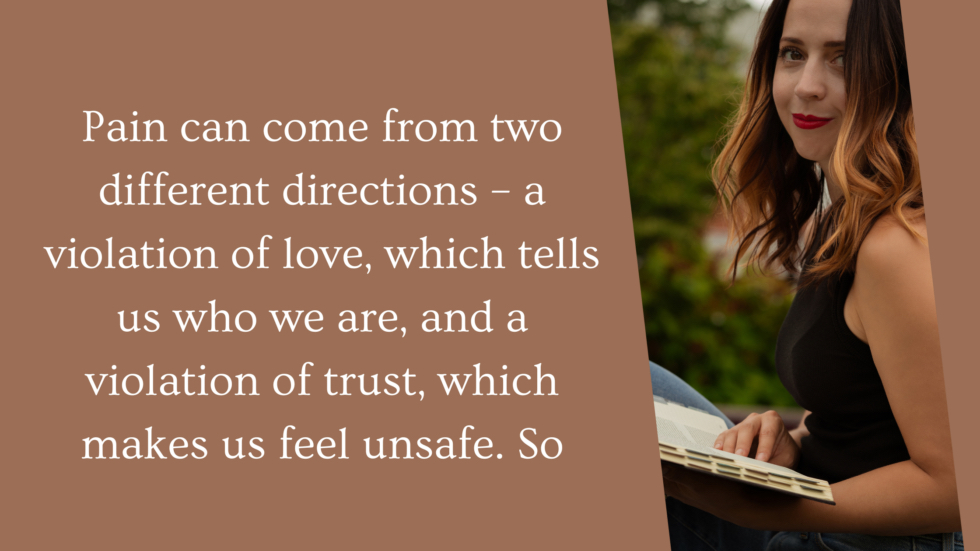
I consider anxiety a secondary emotion. Another word for that might be more of a reaction than a feeling or a primary emotion. Pain can come from two different directions – a violation of love which tells us who we are, and a violation of trust which makes us feel unsafe. So we might feel helpless and powerless, or we might feel like we’re unable to measure up to expectations, that we’re inadequate, or that we’re not good enough for the task we’re being asked to do.
This is what I see probably most often with worry – our brain starts trying to help us out by controlling more than we’re able to by overthinking it and worrying about it. And usually, that’s a sign that we’ve stepped beyond what we’re empowered to do, beyond what we have agency over and choices in, and we’re starting to worry about it because we’re in territory that we don’t have any control over.
I think a huge component when we feel unsafe or when we feel helpless or powerless is being able to say, “Okay, I may not be able to control the entirety of this situation, I may not even be able to control very much of it, but I am a human being who is empowered to make choices.” I can narrate this situation for myself. And so, be aware of the choices we have and be aware of what we would love to control and can’t.
A great journal exercise that I will have clients overcome worry is to draw two large circles on a page and literally just brainstorm what all the choices you have are. What are all the things I can put my energy toward and actually make a difference? And then, in the other circle, let’s brainstorm all the things we would really love to be able to control and can’t. And if you’re a person of faith, I think it’s a great prayer exercise to literally hand that other circle over, knowing that we can trust God with all the things that we are not empowered over. It helps us answer the question, “What does the Bible say about stress and anxiety?”
When we find ourselves worrying about it, it’s a sign that we’re trying to control something that we should be trusting God with. And then, in this other circle, we can think about, “Okay, here are my choices.” And yes, God’s involved in that too. And I can depend on Him through the power of the Holy Spirit to make right and good choices. But that’s where my energy is best spent.
Scripture helps us to heal with the Father. His Word gives us clear instructions on how to handle stress.
Reading to go from hurting to hopeful? Join my 6-week mentorship. 6 weeks of your first necessary steps to welcoming God’s presence into your pain.
Letting Go of Stress and Anxiety: Trusting in God’s Plan for Your Life
First, it comes from living from our identity in Christ. Living loved.
Secondly, it comes to applying the scripture practically and what the Bible says about stress and anxiety.
An example is Moses. Moses alone led millions out of slavery and into the wilderness. Can you imagine the weight Moses must have felt leading so many by himself? Then we read in Exodus 18:14, “So when Moses’ father-in-law saw all that he did for the people, he said, “What is this thing that you are doing for the people? Why do you alone sit, and all the people stand before you from morning until evening?”
Moses met with people morning and night, trying to help them and guide them by himself. Can you imagine the exhaustion? Thinking about the mantle he was carrying to steward God’s people well. Yet he was carrying the mantle alone until his father-in-law gave him this advice. Exodus 18:17-18 says, “Moses’ father-in-law said to him, “The thing that you do is not good. Both you and these people who are with you will surely wear yourselves out. For this thing is too much for you; you are not able to perform it by yourself.”
Jethro encouraged Moses to select honorable, wise, and godly men who could be taught the basic interpretation of God’s laws and instructions.
Moses was doing a good thing, but he wasn’t meant to do it alone.
How easy is it for us to be living stressful lives because we haven’t asked for the help we need? Have we communicated with those around what we need in a kind and loving way?
This leads us to the question. How many good things do we do but exhaust ourselves with them?
What does the Bible say about rest and work? What does the Bible say about the stress and anxiety that comes from striving?
Understanding Stress and Anxiety
But in the case of anxiety, sometimes they aren’t actually real. Those things haven’t happened. There’s not actually something to fear, but we are interpreting it that way. Therefore our body activates. And it’s something that takes place in the brain. There’s an American neuroscientist and researcher. His name is Joseph Ledoe. And he studied emotions in the brain. And he talked about something called amygdala hijacking, which is basically the amygdala, these almond-shaped structures in the center of your brain, are responsible for the fear response.
That’s what activates, and then you have your frontal lobes, which are part of your brain that is responsible for reasoning and decision-making and planning, and sound judgment. But what takes place when we go into fight or flight mode, when we’re triggered, is that your brain literally sends signals to your amygdala, the fear center of the brain, quicker than it goes to the frontal lobes – the thinking and planning center.
So literally, your brain is hijacked by the fear response in your brain, which literally leads to your frontal lobes subsiding. I think we’ve experienced that, right? Where the fear or the anxiety takes over so much that we can’t really reason in our mind, or we’re feeling a little stuck, we can’t see our way out of it. It’s literally our brain being hijacked by the fear response.
Everything we experience happens to our entire being. It impacts our brain and our organs, skin, and physical body. For example, I work with a lot of women to help end their diet cycles. Many women force themselves to eat specific ways thinking about one desired result: to look a certain way.
However, the lack of nutrition, calories, and deprivation is not only affecting the shape or size of their body but their digestion, adrenals, or thyroid as well (to name a few). Dieting can affect how you see and view food and your body. We think dieting is only about weight loss, but it’s impacting our entire being.
This is why we can not throw scriptures at ourselves about stress and worry and hope it all goes away. The event, situation, or trauma happened to all of you emotionally, spiritually, and physically. God’s transformation works from the inside out, not the outside in. He works from the spiritual to the natural.
When emotions like worry or fear arise, we have a chemical response in the body and the brain. They will also occur at an organ and cellular level. We see this happening when something triggers us, and we react without even thinking about our reaction until we ask later, “What just happened?”
We feel it physically with fatigue, tight shoulders, and headaches. These things are common but should not be our normal. Learning what the Bible says about stress and anxiety is our foundation.
Reading to go from hurting to hopeful? Join my 6-week mentorship. 6 weeks of your first necessary steps to welcoming God’s presence into your pain.
Overcoming Stress and Anxiety: Empowered by Your Faith in God.
We overlook the simplicity of scripture. God didn’t make it hard for us to live by His word. But we make it complicated by thinking we have to jump through hoops, make ourselves clean and pure, and get ourselves together first.
In my book Face Off with Your Feelings, I discuss basic principles of why we live in a constant state of stress and how to get out of them.
We live in stress often because we say yes when we should say no. This is a practical step to less worry and stress. You are not overcommitting, and you are not out to people, please. Like the scripture says, “Let your yes be yes and your no be no.” Don’t say yes when deep down, you don’t feel called to help.
Stress and anxiety can lead us to focus on ourselves and on the small things. While overcoming anxiety with Scripture and worship, music, all of that help us step back into the bigger picture of who God is and who He is in our lives. And we just need that reminder, in that shift in our spirits. So yeah, scripture, worship, reaching out to your safe people praying together. I always talk about mental health as a toolbox and we have all these different tools that we use, and they’re all useful and gifted to us by God to be able to use for healing and health. So use all of them and what the Bible says about stress and anxiety.
Combining Faith and Clinical Practices for Healing
The first tip for overcoming stress and anxiety is attentional control. Attentional control is our ability to concentrate. It’s our ability to choose what we pay attention to. Sometimes our brains have a hard time determining what is safe in the present moment. We may not be experiencing a physical threat. However, when we consider a past situation, we may think we are unsafe.
In my book Face Off with Your Feelings, I discuss that when we are conscious of our thoughts, they are most pliable because we are aware and can choose what to think.
Putting this into practice can be simply asking yourself questions or having someone else ask “safety” questions for you.
For example, if you were to say no to going to an event for work or family dinner, would that situation hurt you? Could that person hurt you? Not truly.
Do you have to follow the way of everyone else? No, you are an adult and can make your own decisions.
If you had to walk away from the person you feel hurt by, would you be okay? Yes. In fact, you may recognize the healing that will come from forgiveness through the Lord.
Attentional control is asking yourself questions in the situation to produce safety. (Again, recognizing this is not dealing with situations where there are perceived physical threats in the present. It allows us to be present to the Holy Spirit and consciously choose Him.
The second tip for stress and anxiety is to use your senses and practice awareness to keep you present. One way you can do this is by naming five things you see around you, four things you can touch, three things you can hear, two things you can smell, and one thing you can taste.
This doubles as a gratitude and praising exercise with the Lord thanking him for his blessings and all that you can see, touch, hear, smell, and taste. (We always want to be turning to the Father because apart from him, we can do nothing. We are made in his image.)
Another awareness tip is to say everything you are aware of. For example, I am aware I had mud on my shoes. I am aware I am hungry. I am aware I am sad.
This helps bring you back to the present and find relief.
I love how the Lord made our bodies. We do not live carnally, meaning through our senses, but we do get to acknowledge the goodness of God with them. (And we get to choose to live how the Bible says with stress and anxiety.)
The last tip for stress and anxiety is learning to contain your anxiety and the emotions that come with it in a healthy way. Some would call this containment. For example, closing your journal after being honest with God about your feelings is a symbolic act of containment. Once you close the journal, you are leaving distressing emotions, memories, sensations, and thoughts there. You know they are safe there. This isn’t the same as ignoring your feelings. Little by little, you can take them out of containment and process through them with the Lord and trusted people.
Another example is visualizing (since our imagination is so powerful), giving each individual feeling over to God. I want you to close your eyes for this and picture yourself and Jesus with you, with his hand outstretched, taking every feeling from you.
Let your feelings come before the Lord. It’s where they are safe, secure, and seen.
Anxiety isn’t something you have to accept. It may be common, but it doesn’t mean it has to be normal.
Inviting you to turn your pain into hope! Join my 6-week mentorship. 6 weeks of your first necessary steps to welcoming God’s presence into your pain.
Biblical Verses About Stress and Anxiety: Finding Encouragement in God’s Word
1 Chronicles 16:11
“Seek the Lord and His strength; Seek His face evermore!”
Deuteronomy 31:8
“And the Lord, He is the One who goes before you. He will be with you, He will not leave you nor forsake you; do not fear nor be dismayed.”
Psalm 34:4-5
“I sought the Lord, and He heard me, And delivered me from all my fears. They looked to Him and were radiant, And their faces were not ashamed.”
Isaiah 26:3
“You will keep him in perfect peace, Whose mind is stayed on You, Because he trusts in You.”
1 John 4:18
“There is no fear in love. But perfect love drives out fear, because fear has to do with punishment. The one who fears is not made perfect in love.”
2 Timothy 1:7
“for God gave us a spirit not of fear but of power and love and self-control.”
Isaiah 40:31
“But those who hope in the LORD will renew their strength. They will soar on wings like eagles; they will run and not grow weary, they will walk and not be faint.”
Psalm 94:19
“When anxiety was great within me, your consolation brought me joy.”
Proverbs 3:5-6
“Trust in the LORD with all your heart and lean not on your own understanding; in all your ways submit to him, and he will make your paths straight.”